Dear Critter Readers,
How are you? Happy last day of November!
Lately I have been thinking of eels. My sis JB mentioned that she disliked eel sushi; I concur. Then eels were featured on the "New Scandinavian Kitchen"
show on PBS.
Maven recently mentioned one of the hosts, Claus Meyer, on her blog. Finally, I think Elian used tiny eels in some of his Spanish-flavored cooking last year on "Top Chef".
We must learn about the eel, don't you think?
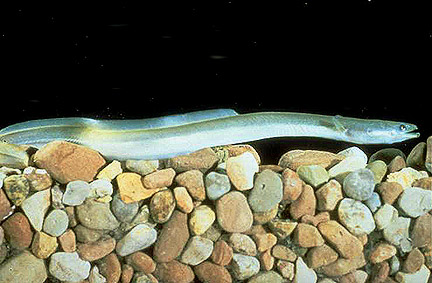
This is the American eel, Anguilla rostrata.
Taxonomically, eels are an Order of the fish family Class Actinopterygius, or ray-finned fishes. There are about 400 species of eels throughout the world. Eels usually live in either shallow water or very deep (up to 4,000 meters down!) in the ocean. Some reside in holes, called, mysteriously, eel holes. Many eels are most active at night and bury themselves in sand, pebbles or other materials during the day. Most eels are carnivorous, and the eels in North America and Europe are beneficial as they are scavengers as well.
American eels, are most commonly found on the east coast of the United States, around Chesapeake Bay and and the Hudson River. Females are larger and can reach four feet long and weigh up to seven pounds. The upper, or dorsal fin connects to the lower, or anal fin, creating one large fin covering the end of the eels body. Two small pectoral fins aid in maneuvering. Eels have very small, fine scales.
For a long time, no one knew where baby eels, or leptocephali, came from. Small eels, or elver, were found at river mouths, and adult eels were found inland in Europe and North America. After searching for fourteen years, the Dutch scientist Johannes Schmidt finally discovered the birthplace of eels in 1922. By measuring the size of eel larvae, Schmidt determined that the tiniest leptocephali were found in the Sargasso sea, an area of two million square miles within the Atlantic Ocean. He hypothesized that the eels must breed there, but no one has ever seen adults near the surface of the Sargasso sea, so scientists assume they mate deep in the water.
But check it; not only are American eels found out east, but also HERE IN MINNESOTA! The Mississippi River is home to these wriggly guys, along with Lake Superior and even rivers in South Dakota! Eels are catadromes, that is, creatures that live in freshwater but must breed in the ocean. So, all eels here in Minnesota have traveled all the way from the Sargasso Sea near Burmuda! And all of them will travel back there to breed at the end of their lives!
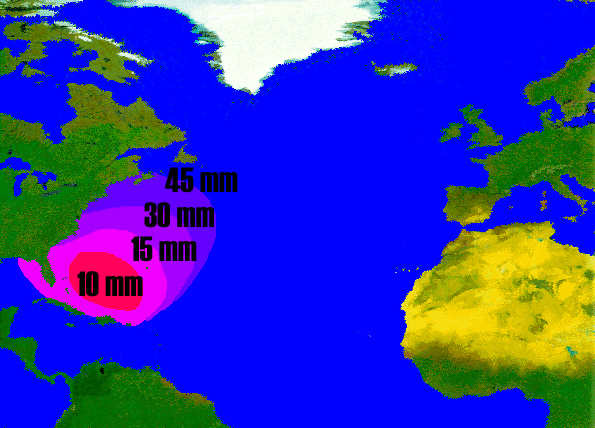
Sargasso Sea = Far away from Minnesota. The numbers and millimeters listed above refer to the size of the leptocephali as they eat plankton, grow and travel away from their birthplace.
Isn't that crazy? Eels have permeable skin which allows them to survive brief overland excursions between rivers. Some kind people even put "eel ladders" alongside dams, which allow the fish to wriggle further upstream. Sometimes eels congregate together to form masses, which can move more easily over obstructions. Obviously, dams, loss of wetlands and hydroelectric plants can disrupt the flow of eel travel. While they're not endangered, conservationists have placed eels on a list of threatened animals.
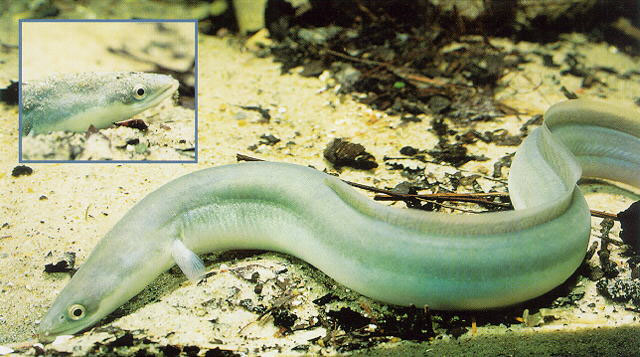
The European eel! Doesn't he have a cute face?
Unfortunately, eel nooky remains mysterious. Let's start with the adults. After about ten years in freshwater, eels somehow know it's time to travel back to the Sargasso sea. They start gorging themselves with food, because during the journey, they gradually stop eating, and their digestive tracts eventually wither away. The eels turn silvery in color and their eyes grow, and some people call them "big eyes" or "silver eels" at this point in their lives. Scientists don't know what happens once the eels reach the ocean. It is known that female eels can release millions of eggs at a time. Males must fertilize the eggs, but no adults return to their freshwater homes after mating.
For a long time, eels in the larval stage, the leaf-shaped leptocephalus, were thought to be a unique species of fish.
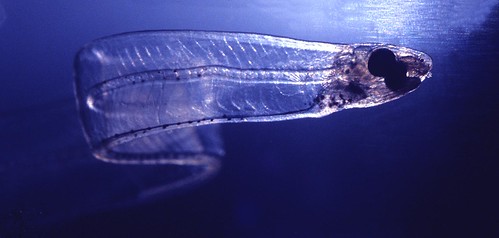
Newborn leptocephali are only 6 mm long, and eat plankton. As they grow to several inches in size, baby eels are called elver, or glass eels. They are very popular as a food source during this time. Once they are large enough, the American and European eels (which appear similar, but are genetically and physically different) begin their journey back to an ancestral river. Scientists don't know how they navigate so specifically. Floating on ocean currents, the American elvers take about a year to reach freshwater, while the European eels take around three years to hit the British Isles and the European mainland.
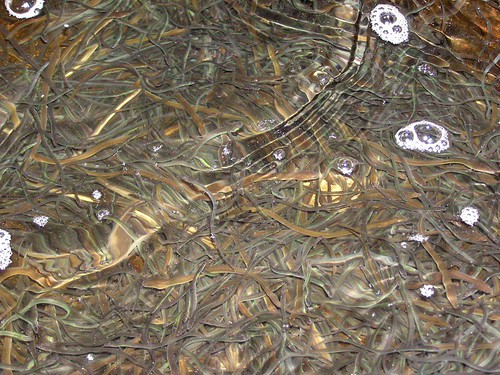
Recently, eels have become more desirable as a food source; Japan and Germany are huge consumers of the fish. While the Japanese have been using aquaculture to raise eels, (they have their own breeding ground near Japan) a parasitic nematode in that species has started to infect the European and American eels. The number of glass eels has dropped in recent years, and like all oceanic fish, eels probably face serious issues as the climate changes and the demand for fish increases.
Have any of you caught an eel? Seen one? Maybe I should get a pet eel for my aquarium! Remember, eels are not the same as
eelpout, which are a member of the cod family. Eels are also a band! Check out this L.A. group
here!
Aren't eels fascinating?
Wiggily,
Wendell!